ESWN pointed out this interview with Peter Hessler that I noticed a while ago. The reason I found it interesting was this part:
Culturally, China is vastly different from the United States. What is the most common Chinese misperception about America and Americans? Conversely, what American clichés about China need to be reconsidered?
PH: The Chinese tend to view America in extreme ways. Some Chinese speak of the US as if everybody there is rich and happy — I’d say this is probably the most common viewpoint among average Chinese. But there is also a lot of talk about American poverty, violence, guns, as well as the bullying tendencies of the American government. This line of thought is often encouraged by the Chinese media. When I taught in Sichuan, my students used a Chinese published textbook called Survey of America, which included one chapter about “Social Problems.” This is a sample paragraph:
“In 1981, in California University, robbery and rape increased one hundred and fifty percent. In a Cathedral school of Washington District, a girl student was raped and robbed by a criminal with a hunting knife while she was studying alone in the classroom. In a California university, a football coach was robbed on campus by someone with a gun. It is said that, in South Carolina University, gangs of rascals have been taking girl students, women teachers and wives of teachers working in this university as their targets of rape, which has caused a great fear.”
You can imagine how frustrating it is for an American teacher to be expected to use such a book to introduce the United States to a classroom of young Chinese. I’m sure that these incidents are true — certainly, there are rascals in South Carolina —and I imagine that the details were culled from American newspaper stories. But that doesn’t make them a useful starting point for students in a small town on the Yangtze. They need context, not a bunch of scattered facts and trivia. When I talk to Chinese about America, I often find myself trying to push them away from the extremes. I don’t want them to think of the U.S. as either paradise or hell. They need to see it in human, everyday terms.
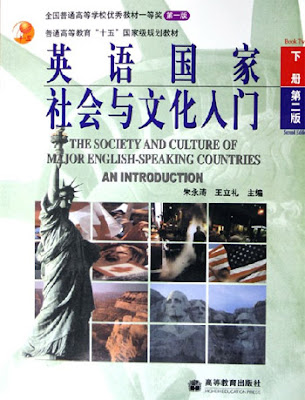
When I taught at a university in Xinjiang in 2005, nearly ten years after Hessler taught in Sichuan, I used a similar textbook 英语国家社会与文化入门, or “The Society and Culture of Major English-Speaking Countries”, published in 1997. A cursory search of edu.cn sites on Baidu shows over 800 references to the book, so it’s safe to say it’s still being used. I don’t have the book anymore, unfortunately, but a course page at Shandong University of Finance does have a summary of the chapter I remember:
Chapter 8: Social Problems in the United States
Focal Point:
racial problems
inequality in American society
discrimination against blacks
the black “underclass”
poverty as a social problem
drug abuse
social costs of drug abuse
crime
the profile of a typical criminal
racial prejudice in the high rate of arrests
white-collar crime
the abuse of power by government
the abuse of power by corporations
The chapter in question had anecdotal stories much like Hessler’s. When I taught from this textbook, I told my students that I was happy to answer any questions about this chapter, but I had no interest in teaching it since the topics it covered were hardly unique to the United States or anywhere else, and my students hardly needed me to point out that Xinjiang suffered from every single one of these problems as well. I did point out to them, however, that I was uncomfortable with the fact that the book (two books, actually) did not have a “Social Problems” chapter for the United Kingdom, Australia, New Zealand or Canada. Only the United States received such treatment. Perhaps the authors wanted to impress upon students that the United States was not, as we say, “all that and a bag of chips”.
The Shandong University of Finance webpage also gives all of the test questions to the book, though it is not clear whether they are from the teachers book or written university faculty. There is no answer key, but perhaps you’d like to try and fill in the blanks.
1. American society is a stratified one in which _______, _______, and _______ are unequally distributed among the population.
2. The largest of the racial and ethnic minorities in the United States is _______ who make up about _______ percent of the population.
3. Former President _______ said that crime is America’s “number one enemy.”
4. Name two of the illegal acts by the FBI: _______ and _______.
5. Name two of the illegal acts by the CIA: _______ and _______.
6. The dominant group in American society that has taken control of economic assets and political power from the beginning of the nation is _______.
7. American slavery was finally abolished by _______, _______ and _______.
8. After the abolition of slavery, many states _______ to keep the races apart in schools, housing, restaurants and public facilities, and kept blacks in the lowest-paid jobs.
9. Those arrested for crimes are disproportionately likely to be _______, _______, and _______ city resident.
10._______ had tested variety of drugs, including LSD, on many people who were unaware that they were being used as _______ and had caused several deaths in the process.
Yes, that is a reference to MKULTRA.
Special bonus question from the Chapter One test on the origins of the United States:
1. Which of the following statements was correct around the time of the American Revolution?
A. The American had the mixed blood of Europeans or their descendants.
B. The American had the mixed blood of Europeans with American Indians.
C. The American had the mixed blood of Europeans with blacks.
D. The American had the blood of the English and their descendants only.


