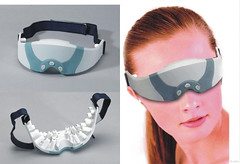
At left: eye massage goggles based on Chinese medicine jingluo principles.
From the Shanghaiist, news of a new batch of eye massage exercises for Chinese students to help combat China’s myopia epidemic. Eye massage exercises in China have good pedigree, being based on the meridian (经络) theories of Chinese medicine. The first modern eye massage drills were created in 1963, revised in 1972 and have been in Chinese schools since 1982. 26 years later, the eye massage drills are being revised again, partly to “take in to account” that, unlike the malnourished students of 1972, current students are “overnourished, fat” and eat too many sweets. In that same article, however, Chinese health authorities caution that the eye protection drills (眼保健操) are not an effective treatment for myopia.
Vision problems are extremely common in China. China Daily reports that “In 2002, a study found 27 percent of primary students and 63 percent of high school students were nearsighted, more than double that of three decades ago.” Clearly the eye exercises weren’t enough to combat increasing myopia. Xinhua reported a more recent study estimating 31.7 percent of primary students and 82.7 percent of university students have impaired vision and that excessive eye strain is believed to be responsible for 45% of the problem.
Not only Mainland China, but Hong Kong, Taiwan, Singapore, Japan, Malaysia and Korea all have higher rates myopia, which has suggested a genetic explanation. But even if a genetic factor is involved, there’s lots of evidence that more nearwork (such as reading) and less sports activity correlate to increased myopia. In one study, rates of myopia in Chinese peasants were found to be around 5%, while scholars had nearly 85%. A study in Taiwan found that older Chinese people and older white people had comparable rates of myopia, but younger Chinese had it far more than younger whites. All of this suggests that with increased literacy and reading in China comes myopia.
The Chinese language clearly involves more nearwork than the English written language. A recent post by Chinese blogger Hecaitou provided a great example of this. There’s an English email forward is an “Alzheimer’s Test” that has three questions like this one:
This is a REAL neurological test. Sit comfortably and feel calm.
1- Find the C below. Do not use any cursor help.
OOOOOOOOOOOOOOOOOOOOOOOOOOOOOOOOOOOOOOOOOOOOOOOOOOO
OOOOOOOOOOOOOOOOOOOOOOOOOOOOOOOOOOOOOOOOOOOOOOOOOOO
OOOOOOOOOOOOOOOOOOOOOOOOOOOOOOOOOOOOOOOOOOOOOOOOOOO
OOOOOOOOOOOOOOOOOOOOOOOOOOOOOOOOOOOOOOOOOOOOOOOOOOO
OOOOOOOOOOOOOOOOOOOOOOOOOOOOOOOOOOOOOOOOOOOOOOOOOOO
OOOOOOOOOOOOOOOOOOOOOOOOOOOOOOOOOOOOOOOOOOOOOOOOOOO
OOOOOOOOOOOOOOOOOOOOOOOOOOOOOOOOOOOCOOOOOOOOOOOOOOO
OOOOOOOOOOOOOOOOOOOOOOOOOOOOOOOOOOOOOOOOOOOOOOOOOOO
OOOOOOOOOOOOOOOOOOOOOOOOOOOOOOOOOOOOOOOOOOOOOOOOOOO
OOOOOOOOOOOOOOOOOOOOOOOOOOOOOOOOOOOOOOOOOOOOOOOOOOO
OOOOOOOOOOOOOOOOOOOOOOOOOOOOOOOOOOOOOOOOOOOOOOOOOOO
Hecaitou made a Chinese one:
最后是令人崩溃的中文版…… 请从诸多的“己”中,找出“已”…….
己己己己己己己己己己己己己己己己己己己己己己己己己己己己己己己己己己己己己己己己己己己己己己己己己己己己己己己己己己己己己己己己己己己己己己己己己己己己己己己己己己己己己己己己己己己己己己己己己己己己己己己己己己己己己己己己己己己己己己己己己己己己己己己己己己己己己己己己己己己己己己己己己己己己己己己己己己己己己己己己己已己己己己己己己己己己己己己己己己己己己己己己己己己己己己己己己己己己己己己己己己己己己己己己己己己己己己己己己己己己己己己己己己己己己己己己己己己己己己己己己己己己己己己己己己己己己己己己己己己己己己己己己己己己己己己己己己己己己己己己己己己己己己己己己己己己己己己己己己己己己己己己己己己己己己己己己己己己己己己己己己己己己己己己己己己己己己己己己己己己己己己己己己己己己己己己己己己己己己己己己己己己己己己己己己己己己己己己己己己己己己己己己己己己己己己己己己己己己己己己己己己己己己己己己己己己己己己己己己己己己己己己己己己己己己己己己己己己己己己己己己己己己己己己己己己己己己己己己己己己己己己己己己己己己己己己己己己己己己己己己己己己己己
You have to squint just to see the difference between 己 & 已. That’s not exactly the case with O & C, though both searches are difficult.
On a more serious note, consider the differences in this eye tracking study of Google and Baidu users. Note the first image comparing eye tracking heat maps for English Google and Chinese Google:

Here’s one of the explanations the author thought was involved:
Another difference is the way we interact with the information in the listings themselves. In North America, we scan and pick up word patterns. We recognize words quickly and determine if they fit in our “semantic maps” (another term covered in our eye tracking studies), but we don’t read the listings.
Because Chinese is presented as symbols, where concepts take their final meaning from a group of combined symbols, it’s much more difficult to scan this information quickly. To try to put in a Western conceptual framework, imagine how difficult it would be to scan meaning from this paragraph if our alphabet was extended to 2000 characters, presented in block letters and all the spaces between words were removed. I can’t do anything about extending the alphabet, but I can change it to block letters and remove the spaces:
TOTRYTOPUTINAWESTERNCONCEPTUALFRAMEWORK,IMAGINEHOW DIFFICULTITWOULDBETOSCANMEANINGFROMTHISPARAGRAPHIF OURALPHABETWASEXTENDEDTO2000CHARACTERS,PRESENTEDIN BLOCKLETTERSANDALLTHESPACESBETWEENWORDSWEREREMOVED
One can begin to understand why it might be difficult to scan and pick up individual concepts quickly.
Perhaps the incidence of myopia in China would be reduced if text were segmented. I wonder what John DeFrancis would say.

 There’s an article in Wired about Microsoft’s Chief Software Officer
 I saw the new James Bond movie in China, where it’s been released a week or so earlier than the United States. The plot centers around a organization called Quantum (think SPECTRE of the old Bond) that engineers a military coup d’etat with CIA approval in exchange for a monopoly on local water management, while diverting water to underground aquifiers on property the new government agrees to give in payment. Once they have the monopoly, they intend to jack up local water rates on poor farmers.