It seems that the relatively new Avaaz.org has decided to launch an ad campaign for a China-Tibet dialogue. Avaaz bills itself as:
a new global web movement with a simple democratic mission: to close the gap between the world we have, and the world most people everywhere want. [“Avaaz” means “Voice” in many Asian, Middle Eastern and Eastern European languages.] Across the world, most people want stronger protections for the environment, greater respect for human rights, and concerted efforts to end poverty, corruption and war. Yet globalization faces a huge democratic deficit as international decisions are shaped by political elites and unaccountable corporations — not the views and values of the world’s people.
Technology and the internet have allowed citizens to connect and mobilize like never before. The rise of a new model of internet-driven, people-powered politics is changing countries from Australia to the Philippines to the United States. Avaaz takes this model global, connecting people across borders to bring people powered politics to international decision-making.
Precisely which model are they talking about? Well, one of Avaaz’s co-founding organizations is MoveOn.org. MoveOn does not exactly have a reputation of making ads that encourage dialogue between opposing sides, probably most famously for the polarizing “General Petraeus or General Betray Us?” in the New York Times. Avaaz also won an award at the Progressive Source Awards for its video “Stop the Clash of Civilizations!”. I have no idea what the Progressive Source Awards are, but it sounds suspiciously like self-congratulations amongst the like-minded.
Avaaz describes their campaign this way on their front splash page:
After decades of repression, Tibetans are crying out to the world for change. China’s leaders are right now making a crucial choice between escalating repression or dialogue that could determine the future of Tibet, and China.
We can affect this historic choice — China does care about its international reputation. But it will take an avalanche of global people power to get the government’s attention. The Dalai Lama has called for restraint and dialogue: he needs the world’s people to support him. Sign the petition below–It has been delivered at Chinese embassies and consulates worldwide, and will continue to grow and be delivered until talks begin.
and then on the campaign page:
The Beijing Olympics are a crucial chance to persuade China’s leaders to support dialogue and human rights in Tibet, as well as Burma and Darfur.
The Olympics are about humanity and excellence. We want to celebrate them, but we can’t while Tibetans and others suffer. Let’s call on China to save the Olympics for all of us — on billboards and ads in major cities, in Chinese overseas community publications, even through a Chinese language internet team.
Our campaign aims to reach out to China and Chinese people to show that we’re not anti-China but pro-humanitarian, and that our desire is to save the 2008 Olympics, not ruin them.
Click on the link at right to see draft ad concepts, and Donate now!
They have a Chinese language internet team! Hey, that’s something I’ve suggested! Unfortunately, this doesn’t sound like a message that’s going to carry well. Starting off with saying the Tibetans have suffered “decades of repression” (What about the rest of China?), which sounds like an accusation, is not good. Moreover, the premise they’re working on doesn’t seem realistic: “China does care about its international reputation. But it will take an avalanche of global people power to get the government’s attention.” Actually, China cares far more about how its own population feels than “an avalanche of global people power”, and right now people are defensively supporting the government. Protests against China have been a PR bonanza for the CCP.
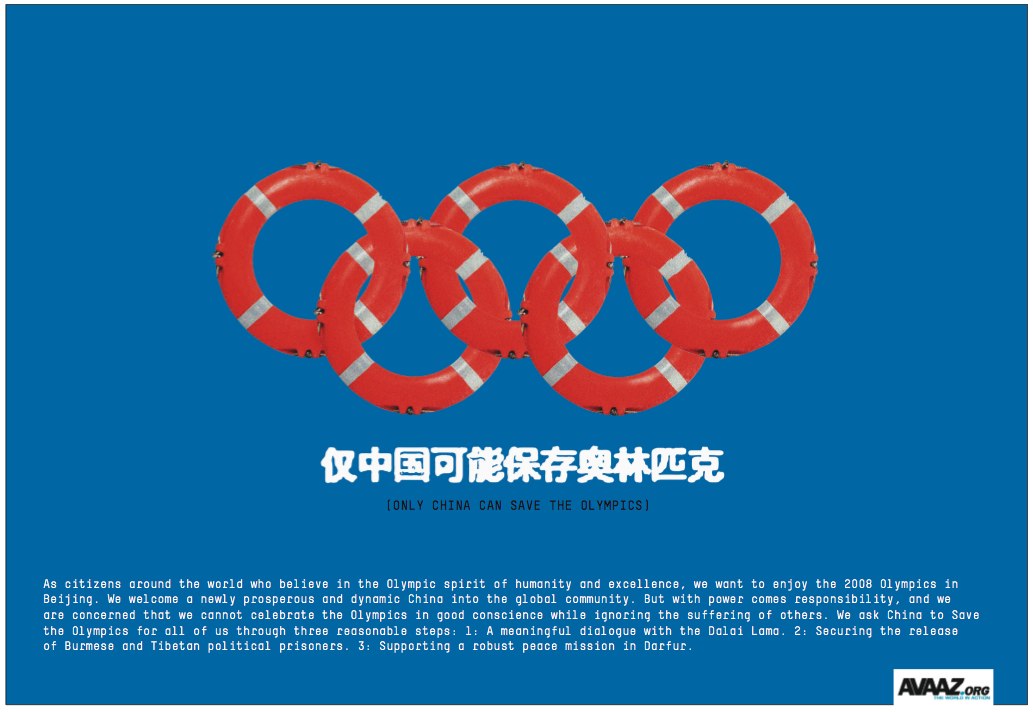
And it gets worse. Check out their draft ads:

OK, all the ads have the same text. This is the only draft ad with Chinese in it. Presumably their translation team will tackle this text. If they produce a different text in Chinese, Chinese viewers will compare it to the English one and if they have any complaints about the English version, the Chinese version will look deceptive. The text is:
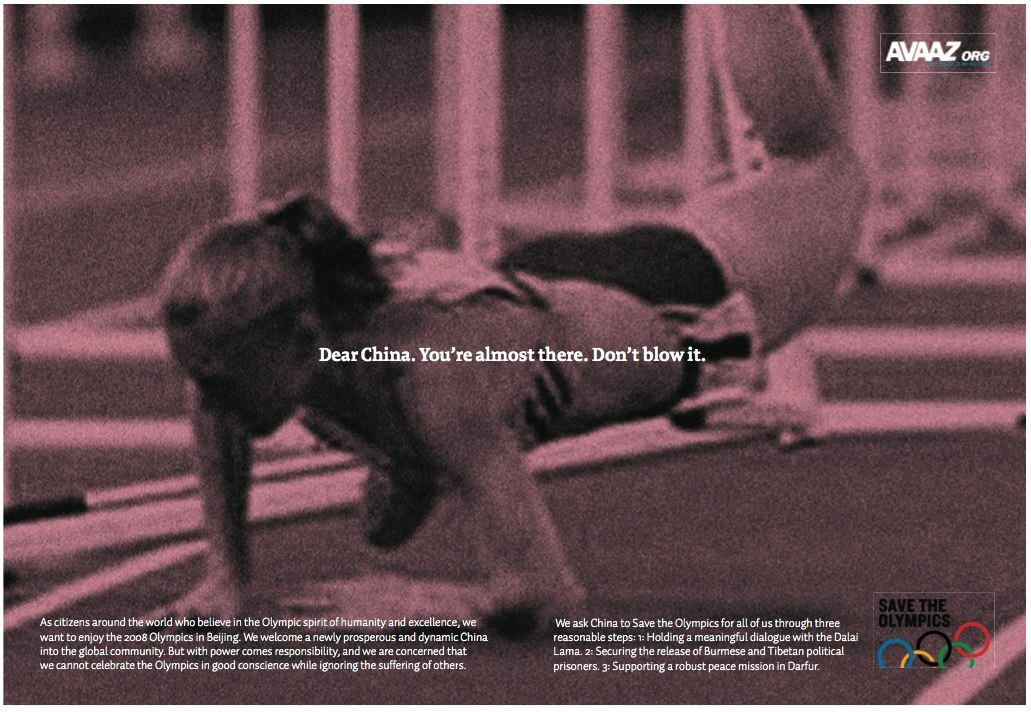
As citizens around the world who believe in the Olympic spirit of humanity and excellence, we want to enjoy the 2008 Olympics in Beijing. We welcome a prosperous and dynamic China into the global community. But with power comes responsibility, and we are concerned that we cannot celebrate the Olympics in good conscience while ignoring the suffering of others. We ask China to Save the Olympics for all of us through three reasonable steps: 1: A meaningful dialogue with the Dalai Lama. 2: Securing the release of Burmese and Tibetan prisoners. 3: Supporting a robust peace mission to Darfur.
OK, Avaaz, I’m gonna give you some free advice on why this isn’t going to fly for Mainland Chinese, or alot of overseas Chinese to boot. Pro-China supporters have made themselves very clear about four things: 1: the Olympics should not be politicized. By saying you can’t “enjoy” the Olympics without certain political concessions, you are ignoring or dismissing what they’ve already told you, not to mention making it sound a bit like “or else!” 2: The Dalai Lama is more persona non grata in China than ever before, and to get a dialogue is going to take alot more than an ad campaign. Your previous effort on Tibet, a petition that garnered 1.6+ million signatures, was received briefly on Anti-CNN with the words “is this a joke?” Meanwhile, 5.6 million people have signed the petition on Sina condemning perceived Western media bias regarding Tibet. If there’s an avalanche of people power in China, does it make a sound? 3: Tibetan prisoners are, in the eyes of the Chinese government and many of its citizens, criminals who are justly imprisoned for committing crimes. 4: Darfur is not China’s fault. Now, there is absolutely a need for a dialogue on these issues. The thing is, your ads are not going to open one. Especially this next one:

“Dear China. You’re Almost There. Don’t Blow It.” That just sounds like a threat. Nice one.
 A word that seems to be cropping quite a bit lately from both